


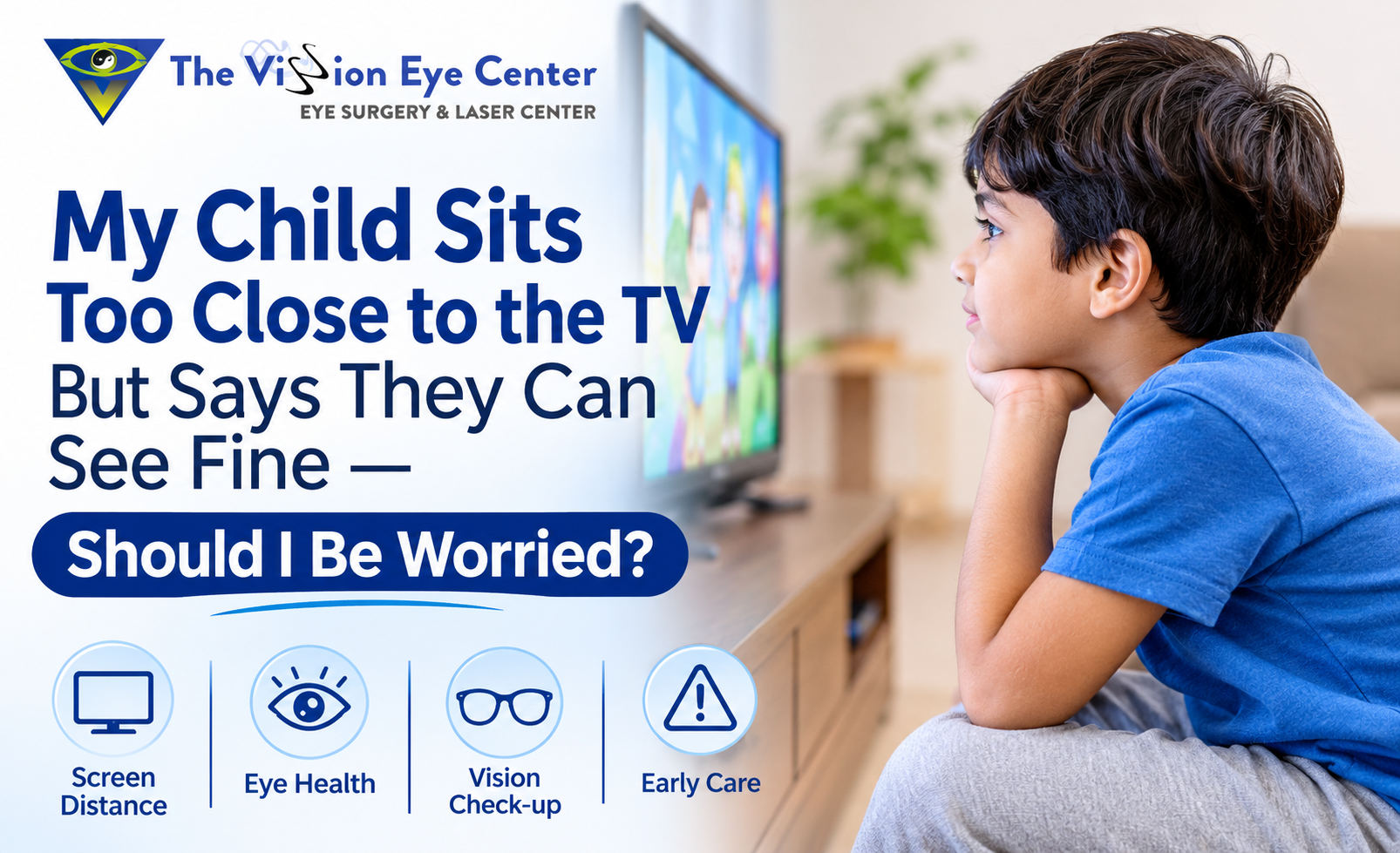
"She Says She Can See Everything Clearly, So Why Does She Sit So Close?"
It's a scenario almost every parent has experienced: your child insists they can see the television perfectly well, yet they consistently inch closer and closer to the screen. It's tempting to write this off as just a habit, or even assume that since your child says their vision is fine, there's nothing to worry about. But here's the important truth every parent needs to understand: your child cannot accurately tell you what they're not seeing. This single fact changes how seriously this seemingly small habit should be taken.
Why "My Child Says They Can See Fine" Isn't Reassuring
This is one of the most important, and most overlooked, concepts in children's eye health: children simply don't have the frame of reference to know when their vision is anything other than normal. A child who has always seen the world slightly blurry doesn't know that other people see it more clearly. To them, their vision is simply "normal," because it's the only version of seeing they've ever known.
This is precisely why sitting close to the TV shouldn't be dismissed just because your child insists they can see clearly. Moving closer is often an unconscious compensation. It's their way of making up for blurriness without even realizing that's what they're doing. They're not being deceptive or exaggerating; they genuinely believe they're seeing things as they should be.
Other Signs That Are Easy to Miss
Sitting close to the television is one of the more noticeable signs, but there are other, sometimes subtler, indicators that a child might have an undetected vision problem:
- Declining academic performance, particularly if it's a sudden or gradual, unexplained drop in grades
- Teacher complaints about difficulty seeing the blackboard, especially in classroom settings where a child is seated farther from the board
- Squinting to look at distant objects, or even to look at things up close
- Holding books, tablets, or devices unusually close to their face
- Frequent headaches or rubbing of the eyes, especially after school or reading
- Avoiding activities that require good distance or near vision, without an obvious explanation
Because children rarely articulate "I can't see well," these behavioral and academic signs are often the only real clues parents and teachers get.
Yes, Children Can Get a Number Too
Many parents assume that needing glasses is something that happens later, typically in the teenage years or adulthood. But refractive errors can absolutely develop in young children, sometimes very young. Children can and do develop a "number," whether it's myopia, hypermetropia, or astigmatism, and it can happen at an age when they're entirely unable to communicate or even recognize the issue themselves.
This is exactly why relying on a child's self-reported vision, "I can see fine, Mom," isn't a reliable way to rule out a vision problem. Without a proper, professional evaluation, a genuine issue can go unnoticed for months or even years, potentially affecting learning, development, and comfort along the way.
Who Should Be Extra Vigilant?
While every child benefits from regular eye check-ups, some children fall into a higher-risk category and should be monitored even more closely:
- Children with a family history of vision problems — If parents, siblings, or close relatives have a significant eye number, the likelihood of a child developing one too is meaningfully higher, due to the genetic component of refractive errors.
- Children with unusually small eyes or other structural differences — Certain physical characteristics can be associated with a higher likelihood of underlying refractive issues and are worth having specifically evaluated.
- Children showing behavioral or academic signs, such as sitting close to screens, squinting, or struggling in school, even if they insist their vision is fine.
The Recommended Starting Point: Age 4
Eye care professionals strongly recommend that all children have their first comprehensive eye evaluation by around age 4, even in the complete absence of any obvious symptoms. This is a proactive, preventive step rather than a reactive one, catching potential issues early, well before they start to noticeably affect learning, confidence, or daily comfort.
This evaluation typically includes dilating the eyes, a simple, safe procedure using eye drops that allows the doctor to get a clear, accurate view of the internal structures of the eye and properly assess whether a refractive error is present, something that can't always be determined through behavior or surface observation alone.
Why Early Detection Matters So Much
Catching a vision problem early in childhood isn't just about comfort. Uncorrected vision issues during critical developmental years can genuinely impact learning, classroom performance, and even long-term visual development. Children are also remarkably adaptable, and sometimes that adaptability works against early detection, because they simply adjust their behavior (like sitting closer to screens) instead of telling anyone something feels off.
The earlier a vision issue is identified, the earlier it can be corrected, whether through glasses or other guided intervention, allowing your child to engage with school, screens, and everyday activities far more comfortably.
The Bottom Line
If your child sits too close to the television but insists their vision is perfectly fine, don't take that reassurance at face value; children genuinely don't know what they might be missing. Watch for other signs like declining grades, teacher feedback about the blackboard, squinting, or general discomfort during visual tasks. More importantly, don't wait for obvious symptoms to appear at all. Every child should have a comprehensive, dilated eye evaluation by around age 4, and this becomes even more essential if there's a family history of vision problems or any noticeable physical or behavioral signs.
If your child frequently sits close to the TV, struggles in school, or simply hasn't had a comprehensive eye check-up yet, it's a good time to schedule one. The team at The Vision Eye Center, a trusted pediatric ophthalmologist in Mumbai, offers thorough, child-friendly eye evaluations, including dilated exams, to accurately assess your child's vision and catch any issues early. A visit to an experienced eye specialist in Mumbai can give you genuine clarity, rather than relying on guesswork or your child's own perception of their vision.


